Skip to content


Technical reviewer of a book about computer vision projects solved using OpenCV

There is a new book about OpenCV:

Mastering OpenCV with Practical Computer Vision Projects.(affiliate link)

I was honored to be invited to participate as a technical reviewer of the book, and it was really fun to read. Each chapter shows a specific real world problem and teaches you how it can be solved using OpenCV. This is the work of seven authors, and the projects are great. I really recommend this book if you are already using OpenCV, because it deals with more advanced details, and in some cases it shows you how to use other libraries to fill in where OpenCV lacks for specific purposes.

Some of the cool things that this book covers are how to make OpenCV powered apps for Android and iOS, interfacing OpenCV with the Kinect, number plate detection, optical character recognition (OCR), augmented reality, structure from motion, face detection and tracking.

If you are interested in using OpenCV in real world scenarios, this book will definitely help you. Although you will need to know the basics of image processing or computer vision and programming first as this book is mostly focused on the actual practical projects.
Posted in Open Source, OpenCV, Programming.


Playing with astrophotography

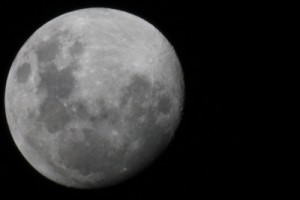
One of the easiest subjects to photograph in the night sky is the Moon. Everyone knows where it is, and it looks large and bright from the earth(well, unless it is in the new moon phase).
moon

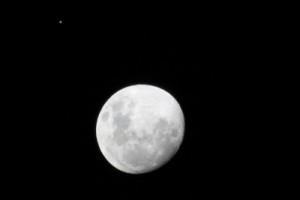
Yesterday, Jupiter was passing close to the Moon, as seen from the Earth.
jupiter_close_to_the_moon

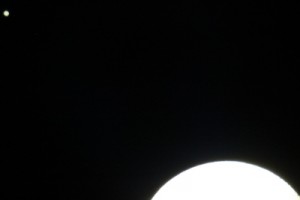
I tried to get a close up of Jupiter and the Moon in the same frame, but the brightness of the Moon was overexposing the photograph.
jupiter_moon_too_bright

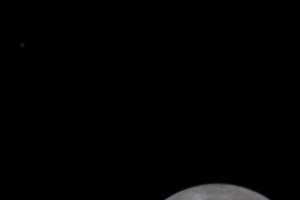
When I properly exposed the Moon, Jupiter was not very visible.
jupiter_moon_too_dark

I could have used HDR techniques here to merge differently exposed photos into a single one that had Jupiter and the Moon properly exposed, but I changed my mind and started focusing on Jupiter alone.

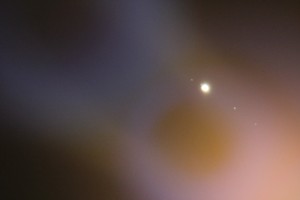
Removing the Moon from the frame allowed me to gather more light from Jupiter and its surroundings, and that’s when four other objects appeared in my picture.
jupiter_four_moons

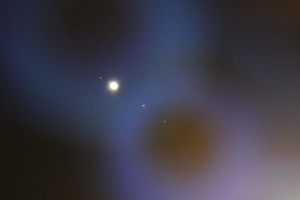
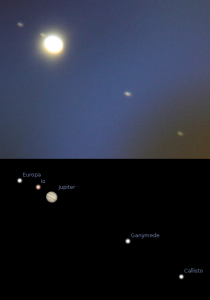
Checking with Stellarium, I confirmed that these objects were Europa, Io, Ganymede, and Callisto. They are the four largest moons of Jupiter!.

I never thought that I would be able to photograph the moons of Jupiter from the Earth using my own camera, but there they are!.
moons_of_jupiter

Here is the previous photo aligned with the simulated sky from Stellarium. Cool!
jupiter_moons_aligned

Posted in Photography.